
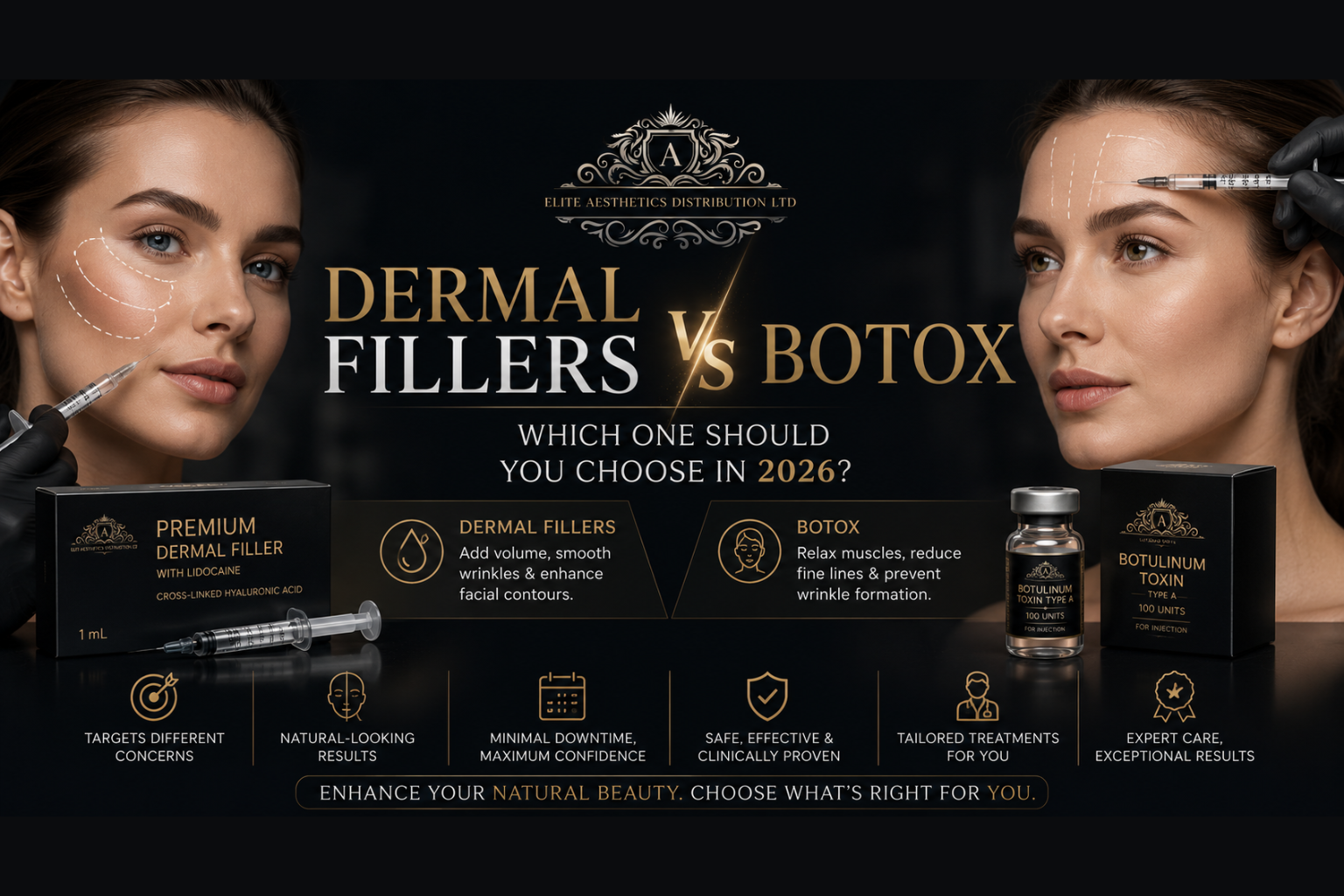
Dermal Fillers vs Botox: Which One Should You Choose in 2026?
If you’re offering aesthetic treatments or sourcing products for your clinic, choosing between dermal fillers and Botox isn’t just a clinical decision it’s a business decision that directly impacts your results, client satisfaction, and revenue.Most clinics get this wrong.They either overuse one product or fail to understand when each treatment actually delivers the best outcome. Let’s fix that.
What is Botox?
Botox is a purified protein used to temporarily relax muscles. It works by blocking nerve signals, which reduces muscle activity and smooths out dynamic wrinkles.
Common treatment areas:
Forehead lines
Crow’s feet
Frown lines
Botox is ideal when wrinkles are caused by repeated facial movement.
What Are Dermal Fillers?
Dermal fillers are gel-like substances injected beneath the skin to restore lost volume, enhance facial contours, and smooth static wrinkles.
Most fillers are based on Hyaluronic Acid, a substance naturally found in the body that helps retain moisture and volume.
Popular treatment areas:
Lips
Cheeks
Jawline
Nasolabial folds
Key Difference: Botox vs Dermal Fillers
Here’s where most people oversimplify:
Botox = freezes muscle movement
Fillers = add volume
But the real difference is deeper:
Botox treats the cause of dynamic wrinkles.
Fillers treat the result of volume loss.
If you use the wrong one, results look unnatural — and that’s where clinics lose trust.
When Should You Use Botox?
Use Botox when:
Wrinkles appear during facial expressions
The goal is smoothing, not adding volume
Clients want subtle, natural-looking results
Botox is fast, predictable, and widely used — but it has limitations.
When Should You Use Dermal Fillers?
Use dermal fillers when:
There is visible volume loss
You want contouring (lips, jawline, cheeks)
You need longer-lasting structural results
This is where premium filler brands make a difference in both safety and outcome.
Why Product Quality Matters More Than Technique
Here’s the uncomfortable truth:
Even the best technique cannot fix low-quality products.
Cheap or unverified fillers:
Break down faster
Give inconsistent results
Increase risk of complications
That’s not just a clinical issue it’s a reputation risk.
Clinics that invest in trusted brands like Juvederm and Restylane consistently deliver better, more predictable outcomes.
Botox vs Fillers: Which One Makes More Money for Clinics?
This is what most suppliers won’t tell you:
Botox = high volume, repeat clients
Fillers = higher profit per treatment
Smart clinics don’t choose one they combine both strategically.
Example:
Botox for upper face
Fillers for mid/lower face
This approach increases both results and revenue per client.
How to Choose the Right Product for Your Clinic
Before buying, ask yourself:
Are my clients asking for natural enhancement or dramatic results?
Do I prioritize longevity or flexibility?
Am I buying based on price or consistency?
If you’re choosing based on price alone, you’re already losing long-term.
Where to Buy Safe, Authentic Aesthetic Products
Not all suppliers are equal.
When sourcing products, you need:
Verified authenticity
Proper storage and handling
Consistent supply
Transparent sourcing
At EAD UK, we focus on providing trusted, clinic-grade aesthetic products that meet professional standards.
Final Verdict
Botox and dermal fillers are not competitors they are tools.
Used correctly, they complement each other.
Used incorrectly, they damage your results and your brand.
If you’re serious about delivering consistent results and scaling your clinic, your product choice is not something to gamble on.
Ready to Upgrade Your Aesthetic Supplies?
Explore our range of premium dermal fillers, lidocaine products, and medical-grade supplies trusted by professionals who care about results.